Care, Welfare & Management
General Care
- Donkeys are desert animals and thus with our wet temperate climate and lush pastures are in a somewhat alien environment. This single factor determines the basis of their care and particularly feeding and how it significantly differs from horses and ponies.
- Donkeys are herd animals and a single Miniature Mediterranean Donkey will be very lonely and unlikely to thrive. They should always have at least one companion. Goats, sheep and ponies are not suitable as companions.
- Two miniature donkeys will require a minimum 1 acre of land. Poor quality or wetness in winter may indicate the need for a greater area. This should be subdivided into sections to ensure against overgrazing and prevent over eating.
- Droppings should be cleared daily from the pasture.
- Miniature donkeys are healthy animals but do require shelter from bad weather. Unlike native ponies, donkeys are not waterproof and a 3-sided field shelter, with entrance facing away from prevailing winds, is the minimum requirement and will also provide shade in Summer.
- Fresh water must be provided daily. Dirty/stale water will not be accepted, even leading to dehydration.
- In freezing conditions, warm water is highly recommended as donkeys will not drink icy cold water. Most donkeys normally need to drink more water in winter than in Summer as they are consuming more dried food.
- We recommend miniatures are stabled at night, especially in winter. Additionally, for security purposes, a stable with security lights is the safest place for such friendly animals all year round after dark.
- A full parasite control programme is necessary throughout the year and regular faecal egg counts (FECs) are a key component of this.
- The same annual vaccinations as for other equines are recommended with protection against Tetanus being the essential minimum.
- Miniature donkeys will need regular hoof care and feet should be trimmed every 8-10 weeks and teeth should be checked regularly.

There is an incredible amount of very helpful information in the knowledge and advice section of the Donkey Sanctuary website. Please click here for direct link.
The Donkey Breed Society also have information regarding the care of donkeys on their website. Please click here.
Worm Control For Your Donkey
Donkeys are affected by several different parasites or worms, and should be checked regularly. Routine faecal egg counts (FECs) are recommended to identify whether your donkey requires de-worming. There is no need to de-worm a donkey if it does not have worms! Unnecessary use of anthelmintics (de-wormers) contributes to parasite resistance.
All equines coming onto your property should be quarantined and treated using Moxidectin (such as Equest) that will treat roundworms and redworm AND a double dose of Pyrantel (such as Strongid P) that treats tapeworm. Animals should then be kept on a yard or in a stable for at least 48 hours before turning out.
PLEASE NOTE: For horses, Equest Pramox is a dual active that will act as a complete quarantine treatment but the active that treats tapeworm in this product (Praziquantel) is NOT to be used for donkeys. So - if you have horses AND donkeys, be sure to only use Pyrantel to treat tapeworm in your donkeys.
Pasture and stable hygiene is vital. Pick up droppings. This is the single best way to reduce parasites on pasture.
Always check with your Veterinarian or SQP about which anthelmintic to use and when. Follow his/her advice. You need to know the weight of your donkey, as this will affect the amount of anthelmintic administered.
The most common parasites or worms to affect your donkeys are :-
- Threadworms - Mainly in foals especially when suckling. Infection comes from the dam causing debilitating diarrhoea.
- Roundworms - Especially in foals. Tends not to damage the gut but competes for food leading to poor development. Severe infestation can cause dangerous colic. Eggs are viable in soil for a very long time. Keep pastures clean.
- Strongyles - These are Encysted Small Redworm Larvae and Migrating Large Redworm and cause large intestine wall damage, bleeding, poor condition and anaemia.
- Bots - Stomach damage. Eggs are visible during summer stuck to hair typically on lower legs. They appear as white/cream tiny grains. Wiping off helps, with a wet sponge/cloth before they get licked off and ingested.
- Tapeworm - Infests the Ileum and small Intestine.
ESTIMATING THE WEIGHT OF YOUR DONKEY
When you need to worm your miniature donkey it is most crucial to know their weight. You will need to know this also for many drugs and anaesthetics as all doses are proportional to body weight. If you don't have access to a weighbridge or method of weighing your donkey, then a means of estimating must be used. Many weigh-bands and formulae were designed for horses and do not suit all donkeys. Similarly some donkey formulae tend to become inaccurate when applied to miniature donkeys. One formula we recommend is a little more involved but much more accurate. Keep a record of weights as this may also assist your veterinarian in the future.
Make sure that your donkey is standing square and is relaxed. Use a measuring tape that is long enough to measure the length of the donkey. It is also advised to have another person or helper present that can assist with holding the donkey and tape.
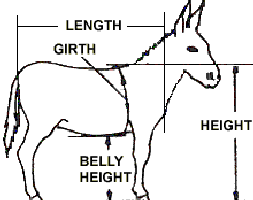
Weight (kgs) = ((Height-Belly height) x Girth x Length) divide 3500
All measurements are in centimetres
As a check most adult miniature donkeys will be in the range 80 -120 kgs
A essential part of parasite control is stable and pasture management. Droppings should be picked up from all donkey areas regularly.